

The practice
What is Kriya Yoga?
Kriya Yoga is the union of the individual soul with the universal or supreme Soul — the science of the evolution of human consciousness into divine consciousness.
ANCIENT WISDOM FOR PRESENT TIMES
The science of the breath
Kriya Yoga is a spiritual science that involves harnessing and directing life-force energy, or prana, for soul evolution. This is done through slow, controlled breathing known as pranayama, for it is the breath that acts as a sacred bridge between the body, mind, and soul.
The body’s life-force moves as several subtle currents. Of these, two are most relevant in Kriya Yoga: one that rises, and one that descends. In ordinary life these two flow in opposite directions, scattering our energy outward and binding us to sensory attachment and restlessness. Through the conscious practice of the breath, Kriya draws them together and into balance. As they meet and unite, the breath settles, the mind grows still, and the freed life-force is drawn inward and upward along the spine.
This has a twofold effect: the rising current expands and refines our consciousness, dissolving the ego, while the descending current helps purify the deep imprints of past karma. Body and mind are nourished and revitalised by the life-force, the nervous system settles, and the practitioner is carried, over time, toward stillness, clarity, and union with the Divine. It is a natural blossoming of our highest nature, aided by keen attunement with the inner Guru.
Harmonising polarity
Shiva and Shakti: The Union Within
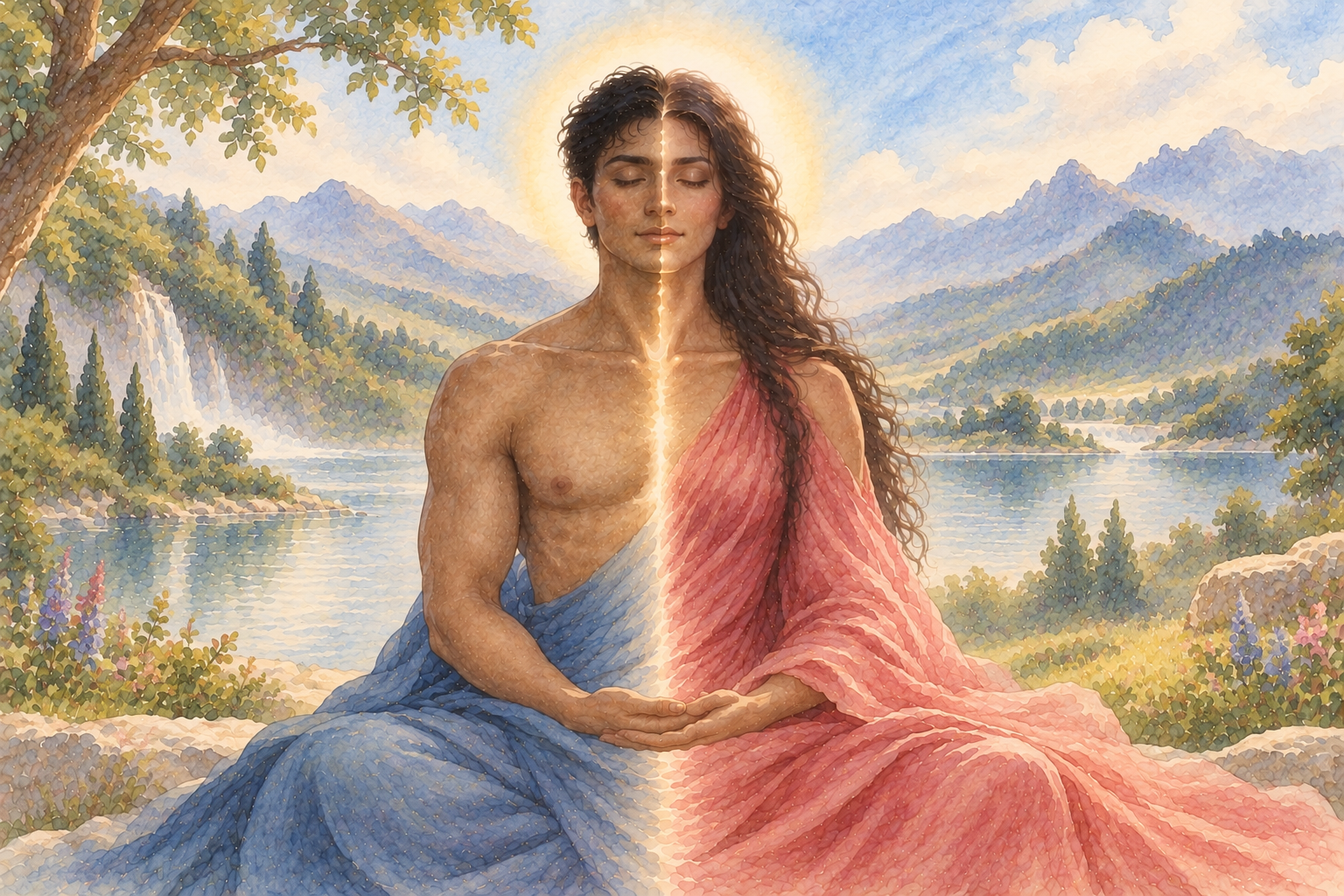
In the yogic view, the human being is a microcosm of the universe: everything out there is also within us. The core of Kriya Yoga, the practice named Shiva-Shakti, rests on this truth. Shiva is the masculine aspect of the Divine: pure, still consciousness. Shakti is the feminine aspect: the primordial energy that manifests all of creation. Before creation, both are united as one undifferentiated, unmanifested consciousness, for God is beyond gender, or any identity at all.
The archetype I have always resonated with is the Ardhanarishvara: complete Divinity shown as half Shiva, half Shakti, not two separate bodies but one wholesome One. It makes visible what the practice works toward. In Kriya, the in-breath is offered to the out-breath and the out-breath to the in, the two currents steadying and slowing to a still point; and as they meet, so too do these inner polarities: the still and the dynamic, the receptive and the active, what we loosely call the feminine and the masculine.
For we too are meant to be whole, not fragmented. The tiny microcosm of the individual self has the birthright to integrate both polarities and dance with them, just as the cosmic creator does. This is why I speak of integration as the very mechanism of love: the reconciling of our own opposites, until we become whole. Love is the highest integrating power, the one that dissolves all conflict and division. It is the heart of the Mother, the feminine within us all; and in its embrace, the two are remembered as one.
The heart-led approach
Felt, not merely understood
Discipline is most sustainable and effective when it’s balanced with gentleness. This path honours feeling, the wisdom of the heart, and the full reality of being human. The mind loves to complicate and explain; the heart simply knows. We begin with the heart, and let the whole practice be felt, not analysed — for it is feeling, not thinking, that carries us home.
Inner peace
A calmer, more spacious mind that can integrate all of life’s experiences, even the polarising ones.
Clarity
Seeing your choices, your patterns, and life itself, with greater awareness.
Steadiness
Meeting your emotions from a grounded, centred place, steady through the changing winds of life.
The flowering of love
A soft opening of the heart towards love, compassion, and service.
These are the potential fruits of sincere practice, but they are not given as substitutes for medical or psychological care.

Who it is for
A path for ordinary lives
You need not be very flexible, experienced in meditation, or part of any particular faith. This is a path for people living full, everyday lives, with families, work, and all the beautiful mess of being human. You need not leave your life, your beliefs, or your responsibilities behind. The Divine is not merely transcendent, but intimately present in the midst of material life. This practice is a simple way of meeting yourself each day, until you remember that you, too, are Divine.