
ARTICLE · 9 March 2026
Healing the Genders: How Integration Can Make Us Whole Again
Why healing the deepest fracture in humanity begins within.
You are invited to take a deep, slow breath in, counting up from 1 as you inhale, steadily taking in a refreshing stream of air. Notice your lungs expand with each second that passes by.
Keep inhaling.
Does it feel like your lungs are reaching capacity? What if you were asked to continue the in-breath indefinitely? That would be impossible, right? At some point, your body will need to exhale in order to survive; it must allow the inhale breath to take centre stage once more.
I’ve always felt that nature can be the most marvellous teacher, if we choose to pay attention. At the most fundamental level we are shown that life is inherently cyclical. We can observe this phenomenon everywhere: our circadian rhythms, earth’s rotation, seasons, lunar cycles and even life itself exhales at death.
We accept natural cycles as mere rhythmic movements of life: day and night, inhale and exhale etc. These cycles contain polarity within them but we are okay with that. However, our minds struggle to cope with certain kinds of polarity – the ones that can be easily attached to identity, ideology or moral judgement.
Here the ego feels on edge, often needing to defend its allegiance or calcify its position against a perceived threat to survival. Such polarities tend to feel linear and zero-sum. Gender, religion and politics are some of the hot button ones. There has to be winners and by extension, losers.
Or does there?
Polarity does exist, but we were never meant to let it polarise us. We tend to tether our thoughts, beliefs and convictions to one end or another, making way for more suffering.
Perhaps greater healing can come through embracing and integrating the more challenging polarities within ourselves, rather than expecting “perfect” outcomes from a world that is imperfect by design.
Our world through the lens of gender
Throughout my early childhood the question of gender never really entered my consciousness, mainly because it wasn’t a big deal to me. People were people and how they made me feel was far more important than what they looked like. I was happy to wear the pretty dresses my parents put me in and still climb trees wearing them. I was equally comfortable playing in a simple shorts and t-shirt outfit with wild hair. Dolls, teddies, remote control cars and robots were all appealing to me in different ways.
It was only during my pre-teen and early teenage years that I started noticing a shift in my worldview. A child absorbs far more than we realise. They notice when they are viewed and treated differently from others, and they may trustingly take to heart all the little comments adults make about them and around them. I won’t get into all the hurt but I will name the incident that lit a fire within me. The message that Asian families prefer to have at least one son to be the heir had been imprinted in me through various channels. After all, the daughter will get married and move away – so who can parents rely on to continue their name, values and traditions? I prefer not to judge people’s individual choices, but rather look at systemic patterns of thought that shape entire generations, either helping them evolve to greater heights, or limiting them. It won’t come as a surprise that I found this particular view to be extremely limiting.
However, it was when people started bringing their unsolicited views on the matter to my parents that I eventually spoke up. Not once, but on numerous occasions, sometimes within earshot, I would hear them encourage my parents to have a son to fill a void they never knew they had.
As a daughter and only child, each time I heard this it felt like a dagger to the heart, and the wound was shame.
Why wasn’t I enough?
I don’t know what went through my mind when one day, I walked up to them, looked them straight in the eyes and said, “I am both a daughter and son to you.” The words came out of nowhere and truly surprised me. In that moment, my voice rang out with a crystal clarity that I had to dig deep to find again in the years to come.
My parents were amused by my remark and didn’t take it too seriously, partly because in their eyes, I was not deficient or lacking as a daughter in any way. They didn’t even need to hear it. It was only years later that we, as a family, started realising the importance of this innocent but powerful message. I was only 14 or 15 years old at the time, but I knew that there was a boundless potential within each of us that we hadn’t yet recognised.
We need compassion, not judgement
Like many of us, I too have had countless negative experiences on the basis of gender: rejection, dismissal, being spoken down to and having boundaries crossed inappropriately. Some of the people and situations I encountered felt surreal. It’s hard to describe what it feels like when the person standing before you doesn’t regard you as an equal human being, and lets that be known.
It is human to feel anger at such blatant unkindness, especially when it becomes clear that it’s not a one-off occurrence. However, it never felt right in my mind to make sweeping generalisations about any group of people, as if they were all cut from the same cloth. If I had let myself indulge in bitter feelings of indignance and resentment, my heart would have closed up for good and I’d have found myself developing the same attitudes as those who dismissed me. The same ignorant shoe, but on the other foot. Everyone ends up worse off for it.
There is no doubt that in certain parts of the world there is no scope at all for such a discussion to take place; the plight of many girls and women is still horrific. Whenever humanity is being figuratively or literally destroyed, people face no choice but to take action. I consider myself fortunate to live in a society where everyone is allowed to have a voice, at least by law. I speak from that position as an advocate for integrated and embodied living.
By and large, my view on this issue is filtered through yogic, spiritual and humanitarian lenses. We are all souls here on a journey back to our Source, whether we call it God, Self, Nature, Love or Consciousness. In this process, we are meant to appreciate our humanity by trying to understand ourselves and each other, especially the parts that seem alien to us. In doing so, we gradually realise that there is really nothing outside of us. There is no “other” gender, race, colour or creed. We were meant to rejoice in these differences and learn from them, not use them to split ourselves apart.
Before proceeding further, I pause to honour all compassionate, kind-hearted and loving souls that inhabit male bodies. There are so many, with my grandfathers, father and spouse being just a few of them.
A dynamic balance of masculine and feminine
Gender polarisation is arguably the deepest fracture humanity is facing today. Why? Because it affects every single one of us in a very palpable way. It plays out in our relationships, our societal structures and most heartbreaking is how it fractures us internally.
Healing this fracture does not mean we deny gender; integration is the very opposite of denial. It is an unconditional and complete acceptance of the entire human experience within one’s own being.
We can accept that there are obvious physical differences between men and women, as well as differences in tendencies of the mind and emotions. These are only tendencies, not rigidly fixed states. We loosely refer to the mind’s activities as being left-brained (masculine) or right-brained (feminine), but the reality is more complex than that.
Some of the masculine functions are will power, reason, determination, structure and action. Some of the feminine functions are intuition, creativity, adaptability, compassion and love. It is clear to see that any individual requires a healthy mix of both masculine and feminine qualities to have a well-rounded life.
Too much reliance on will and reason can render us cold and unfeeling. Equally, flowing without structure or discipline makes it very hard to accomplish anything. When both masculine and feminine poles serve each other according to the need of the moment, we have a more enriched and harmonious journey.
Like the river, we can gently meander and take in all that life has to offer, while still flowing with purpose towards the ultimate ocean.
The forgotten feminine: A wound both men and women share
Some speak about feminine empowerment in terms of reclaiming power from a patriarchal society, pushing past limitations and striving to achieve what was once thought impossible. Others place greater emphasis on honouring the feminine that already exists, but has been suppressed in order to “make it” in a world that materially rewards outer strength, ambition and dominance more than qualities like compassion and love. All of these viewpoints are valid and meaningful to those who hold them. Sadly though, in striving to prove their worth or fulfil social obligations, women can sometimes forget that they too are human beings in need of nurturing, love and kindness.
With significant progress in women’s literacy and opportunities, it is natural and respectable that they choose to pursue ambitious goals which allow their talent to shine. It is also respectable when women choose to tread solely on the path of family life. Neither choice diminishes the qualities of the soul. Neither choice prevents one from contributing to society in their unique way. Shrouded in history are innumerable untold and lesser known stories of remarkable women who were intelligent, wise, artistic, courageous, driven and accomplished in their own right.
The deeper wound that I feel called to address is ironically not about women at all. Many voices are gathering collectively in acknowledgement that we have diminished and forgotten the feminine aspects of humanity, but they usually speak with women in mind. We often overlook the harmful impact this conditioning has had on men.
Boys are often raised to value the traits of “real men”, such as strength, power and bravery. They are shown time and time again that any display of vulnerability or emotion is a sign of weakness – an apparent feminine trait. They are instilled with the belief that somehow gender is a zero sum game: a power struggle where one must retain the upper hand or lose out to the other side. As a result, men learn to suppress an innate part of their nature so deeply that they forget it ever existed.
What gets forgotten soon starts feeling unfamiliar and strange to us. What feels unfamiliar and strange starts becoming something to be suspicious of. Yet, we can’t help but be drawn to it because it’s a piece of us that we haven’t quite placed yet. The absence of it feels just as unsettling as its presence. We might start seeking it externally in our relationships or mould our society in a way that ensures we fill this void.
In other words, when men aren’t allowed to respect the feminine aspect of their natural self, the harmful effects most certainly spill over to all of humanity. I strongly believe that the most potent, lasting changes start from within.
What if more individuals decided to give a little more grace and understanding to this delicate subject instead of judgement?
What if we allowed the virtue of strength to stand for itself without the false dichotomy of weakness?
And what if this notion of “weakness” was replaced with gentleness.
Perhaps more men would feel safe to embrace their inner gentle-man, without feeling that strength has to be compromised. That said, I feel that no man needs to wait for external permission from anyone in order to fully accept himself and begin the healing process.
The reclamation of power starts with a simple reply to the status quo: No.
Gender as cyclical instead of linear?
One of the first ways to approach healing is by reconsidering all that we have accepted as absolute truth so far. Then, we might open our hearts to the possible reframing of these ideas in a way that brings people together rather than divides them – a more integrated framework. What I’m about to offer is merely a personal realisation that has greatly helped me in my own understanding and healing. If there’s a chance it can help others, it’s worth sharing. Everyone is entitled to their own thoughts and feelings; there’s no imposition that this is the best or only right way to think about this subject.
We tend to speak of gender in terms of spectrums, but these spectrums are often measured as linear. Male on one side, female on another. Even if we accept all the nuance along the line, any single position taken is still more of one side, less of another. In essence, this poses gender as a zero sum game. We explored earlier how this type of framing could have harmful psychological effects.
Some more complex models of gender understand it to be multi-dimensional. These models primarily include 3 variables: the physical gender, an internal sense of identity and the social or cultural aspects which shape how gender is expressed outwardly. Many have delved even deeper into this and expanded the framework further, pointing to gender being more fluid and non-linear in nature. The level of complexity can feel daunting and hard to understand or keep up with. But perhaps it’s healthy to make space for a little complexity, as it is spaciousness that allows for deeper integration.
My intuition arrived with the appearance of simplicity. However, as I explored the thought further, I realised a whole world was in there waiting to be unpacked.
Remember the uncomfortable breathing experiment laid out at the start of this article? We unanimously agreed, I hope, that a person cannot keep inhaling forever. As we inhale, the potentiality for the exhale is always there, and vice versa. And so our breathing is aptly named the respiratory cycle.
What if, like our breath and countless natural phenomena, gender was also cyclical in nature? Multi-dimensional, but also connected polarities. At close range, we perceive linearity, but with distance (space), we may start seeing the curvature. If gender is cyclical in nature, then even when it feels like purely masculine qualities are dominant, the potentiality for the feminine is always there. Even when feminine qualities are expressed more, the masculine is still always there.
Practically speaking, we are all cycling between polarities in all areas of our lives. We express ourselves according to the needs of the situation. Even creative work, which is often thought of as right-brained work, actually involves the use of both brain hemispheres. No half of a healthy brain is ever fully shut-off; the left and right brain are in constant communication and collaboration. It’s just that certain tasks may require more activity from one side, but this doesn’t mean that the other side is completely dormant.
Yet theoretical models, however useful in understanding processes and mechanisms, rarely satisfy the soul. There’s a deeper part of us that can’t remain content with intellectual understanding alone. It needs to experience and feel truth for itself. Many people turn to spirituality in order to quench this thirst.
Some spiritual traditions acknowledge the need for both masculine and feminine qualities to be in a healthy, dynamic balance for soul evolution. Both wisdom and compassion are needed, just as the bird needs both wings to fly.
My inner exploration drew me to make parallels from a popular spiritual archetype: the Ardhanariswara.
The Ardhanariswara: The internal union of masculine and feminine
A yogic view
In yogic parlance, the human being is a microcosm for the universe, meaning that everything out there is also within us.
When referring to yoga here, I speak of meditative practices such as kriya yoga, which aim to liberate the soul from material bondage. In this path, the in breath is offered to the out breath and vice versa, steadying itself at first and then progressively slowing down to a still point. This stillness coincides with a cessation of thought, and along with it all the troubles brought on by the thinking (or overthinking) mind.
The deeper we can go into stillness, the more peace we can experience as we expand our consciousness. It’s hard to imagine anyone not wanting peace. But wait – if all thoughts are stilled, then no action can stir from those thoughts either. When we enter the deepest states of consciousness and remain there, we no longer participate in the material world. This is the path of the ascetic or renunciant; one who casts off all things worldly and dedicates their life to inner realisation.
This is a path I felt most naturally inclined to follow from a young age. When I was 8, I announced to my parents that I would be leaving for the Himalayas. Far from taking it seriously, they found my comment amusing, especially since I had no money of my own or any idea how to get there from the UK. A few years later, at the age of 12, my Divine Mother indicated to me that my path was not one of renunciation. Though I was disappointed to have my himalayan cave dreams thwarted, in recent years I have realised what a gift this turned out to be.
Life was trying to teach me a far more advanced lesson than I appreciated: to remain in the world, fully honouring the Divinity within creation and the Divinity that transcends it. And what was the Divine power within creation? The feminine aspect of God, the Divine Mother or Shakti. The one we tend to forget, underestimate or misunderstand.
The dance of creation
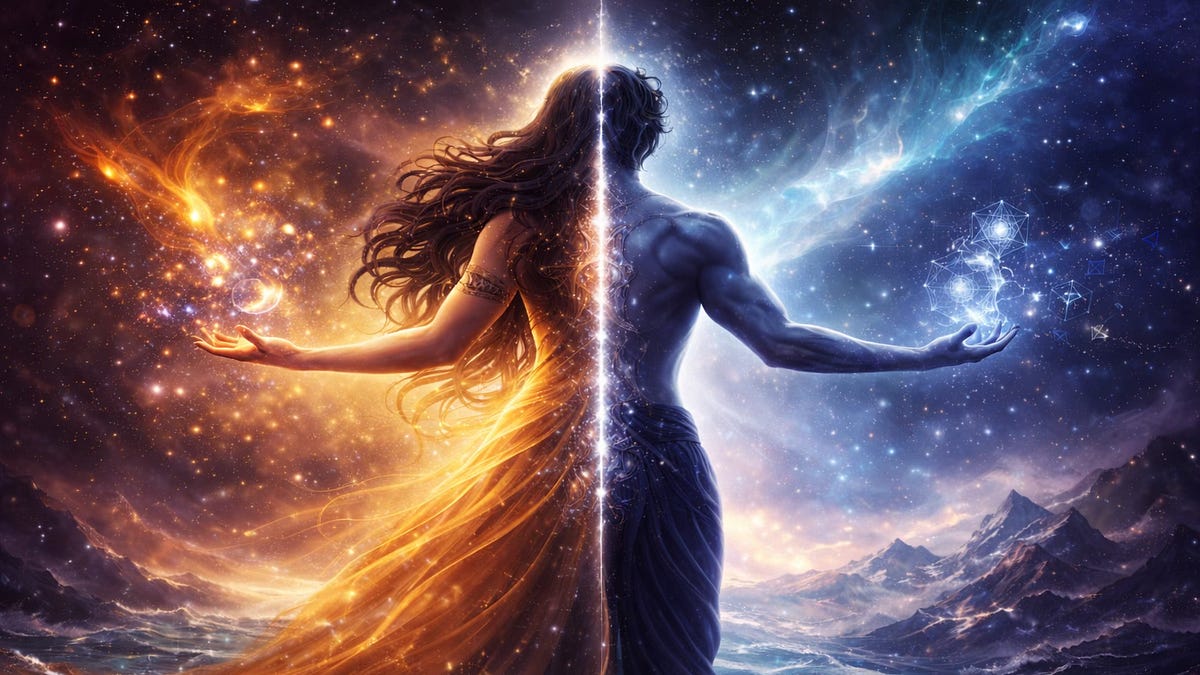
Multiple traditions, particularly eastern ones, honour the concept of a unified masculine and feminine. The yin-yang symbol, rooted in Taoism, is one of the most popular ones. The depictions may differ based on philosophical understanding, but they all point to a deeper integration of our nature. The archetype I have always resonated with is the Ardhanariswara: complete Divinity presented as half masculine (Shiva) and half feminine (Shakti). No two separate bodies here – just the wholesome One.
Shiva is understood as the masculine aspect of the Divine, or pure consciousness. Shakti is understood as the feminine aspect of the Divine, or the primordial energy that manifests all of creation. Before creation, both are united as an undifferentiated, unmanifested consciousness. God is beyond gender or any other kind of identity.
When the Shiva principle sparks the movement and descent of Shakti, the dance of creation begins. The Divine Mother manifests all that we can perceive via our mind and senses, and even all that which is beyond ordinary perception in higher dimensions. She delights in variety and makes this known through nature. All the beautiful things of the world that bring us joy and peace are the colours of her rainbow. Even the not-so-beautiful things are simply another facet of hers.
She is the master teacher, showing her children how to experience, learn and rejoice in life. She patiently waits for the child soul to learn all that it needs to in this temporal human experience, and when the soul has had its fill of life, she takes it back home – to Shiva. This is the process of an individual soul’s evolution of consciousness towards the universal consciousness of Shiva.
At the destination, the Mother and Father reunite, embracing the prodigal soul child in their cosmic arms. The entire journey of a soul is understood as a cycle: the initial descent into creation, the learning and integrating process throughout lifetimes, and the final return back to Source. The meeting of Shiva and Shakti at the end of the journey is the ultimate integration.
The salient point here is that though Shiva and Shakti perform different functions, both are always present and collaborating harmoniously with each other. Without consciousness, all matter in creation would remain inert and without the creative energy, consciousness would remain in its still state. As the Divine Mother performs her duties within creation, the Divine Father consciousness accompanies her at all times. When both aspects of the Divine are merged in unmanifested consciousness, the potentiality for creation is still always there. It’s not just the individual soul’s journey that is cyclical, but the fabric of creation itself.
Above is a very rudimentary understanding of how both Divine principles work. But what does it mean for us? It means that we too are meant to be whole, not fragmented. The tiny microcosm of our individual self has the birthright to integrate both polarities and dance with them just like the cosmic creator. This doesn’t just apply to gender, but all areas of life where we face polarity…which is pretty widespread these days!
A simple self-reflection: how comfortable are we holding opposing views without taking rigid positions and defending them, and without compromising our own values or boundaries? Are we able to feel compassion and love even for those who we don’t necessarily agree with, or whose behaviour we don’t always like? Love is the highest integrating power that will dissolve all conflict and division in humanity. It’s the heart of the Mother; the feminine within us all.
It can be incredibly insightful to examine our own level of integration regularly using self-reflections like this. Just bringing awareness to our thoughts and emotions is a powerful step towards healing. It often happens that when we start working on ourselves for the better, the pleasant fragrance of transformation naturally spreads to those around us. Greater peace, love and joy are just some of the gifts that we get to share with others even without meaning to.
Now, this article is in no way prescriptive. It does not suggest a specific balance of qualities that one should aim for. It also doesn’t judge how individuals work things out between their own relationships or households. It only offers a perspective. One that may facilitate the inner healing of a wound so ancient that we have learned to live with it.
An integrated perspective usually doesn’t leave much room for judgement within itself. It is far too compassionate for that. It allows people to be exactly where they are, and simply invites them to be a part of the dance.
And when the dance is finally over, everybody gets to go home.
Kiruthika Rajeswaran